
Electric vehicles are becoming a more familiar sight on roads across the UAE. From daily commutes in Dubai to longer drives between Abu Dhabi and Sharjah, more drivers are discovering the convenience of owning an electric car. But once you’ve bought an EV, there is one important question to answer: where and how will you charge it?
Finding the right charger is not always as simple as picking the fastest model available. Different chargers suit different vehicles, parking spaces, driving habits and budgets.
For someone living in a villa, overnight charging might be enough. A hotel may need several chargers for guests, while a delivery company could require powerful equipment to keep its vehicles moving throughout the day.
Understanding the types, costs and features of EV chargers in UAE can help you choose a solution that works for your needs today and in the years ahead.
Understanding How Electric Vehicle Charging Works
An electric car stores energy in a battery, much like a smartphone. When the battery runs low, it needs electricity to recharge.
The main difference is that an electric vehicle has a much larger battery and requires dedicated charging equipment.
A charger supplies electricity to the vehicle, while the car’s charging system manages how much power the battery can safely accept.
Charging speed depends on several factors, including battery capacity, charger power, vehicle compatibility, battery temperature and current charge level.
For example, connecting a vehicle to a powerful charging station does not automatically mean it will charge at that station’s maximum output. The car must also support the available charging power.
This is why understanding charger types matters before making a purchase or planning an installation.
Types of EV Chargers Available in the UAE
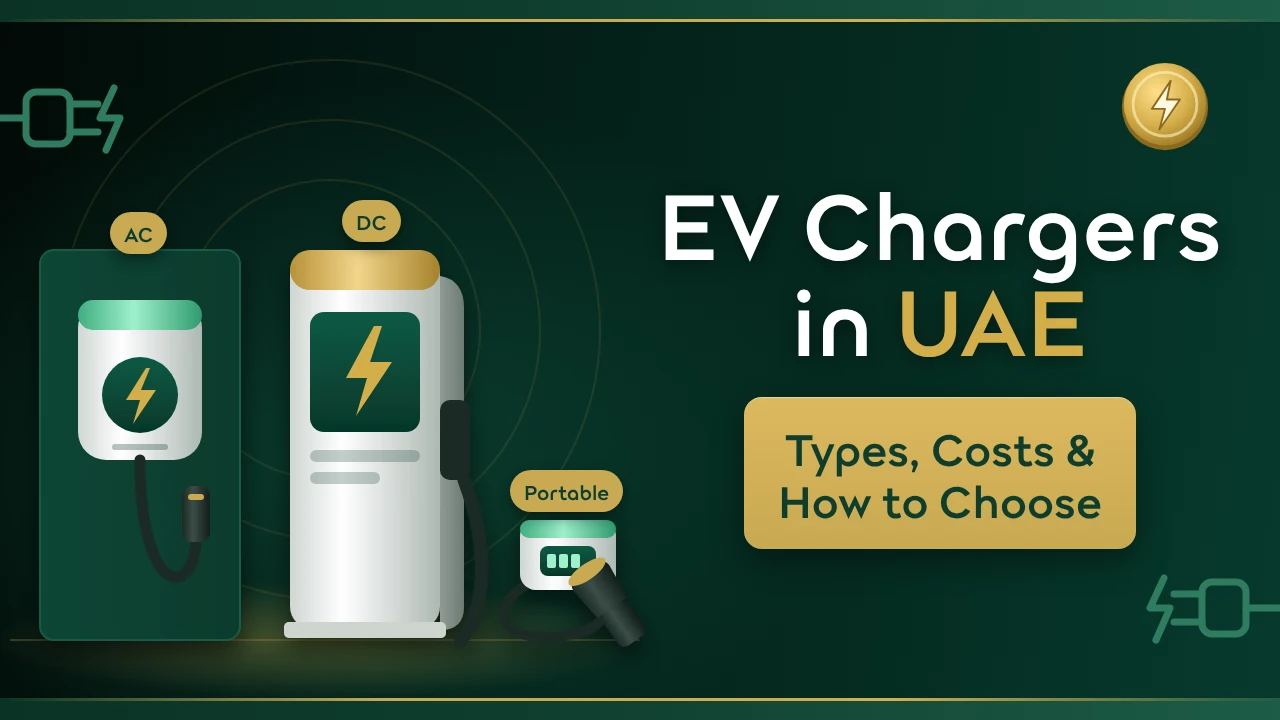
There are two main charging technologies used for electric vehicle charging: alternating current (AC) and direct current (DC).
Within these categories, chargers come with different power ratings and are suitable for different locations.
1. AC Chargers for Homes and Everyday Parking
AC chargers are commonly used in villas, residential communities, offices and parking areas where vehicles remain parked for several hours.
Typical power ratings include 7.4 kW, 11 kW and 22 kW, depending on the electrical supply and equipment.
Many EV owners prefer AC charging because they can plug in their vehicle after returning home and leave it charging overnight.
For example, if you live in a villa in Dubai and travel mainly between home and work, a suitable wall-mounted charger could cover your daily charging requirements without regular visits to public stations.
However, actual charging speed depends on the vehicle’s onboard AC charger. A car that supports only 11 kW AC charging will not charge at 22 kW simply because the installed unit can deliver that power.
AC charging is generally a practical choice when convenience matters more than the shortest possible charging time.
2. DC Fast Chargers for Quick Charging
A DC charger sends direct current to the vehicle’s battery, allowing compatible vehicles to charge more quickly than with typical AC equipment.
An EV fast charger is particularly useful in places where drivers cannot leave their vehicles parked for several hours.
Common applications include:
- Public charging locations
- Shopping centres and busy commercial areas
- Highway service locations
- Taxi and transport operations
- Delivery and logistics fleets
DC chargers are available at different power levels, including 50 kW, 120 kW, 150 kW and higher.
Some high-performance equipment delivers substantially more power, but the vehicle, electrical connection and site infrastructure must be compatible.
Fast charging is convenient during a busy day, although charging speed usually reduces as the battery approaches a high state of charge.
3. Portable EV Chargers
A portable EV charger can provide additional flexibility, particularly for drivers who travel frequently or need a backup charging option.
However, portable charging equipment should only be used with a compatible, properly rated electrical supply.
A regular household socket should not be treated as a substitute for a professionally installed charging point without checking its suitability.
For everyday use, a dedicated charging setup is often the safer and more convenient long-term option.
AC vs DC Charging: Which One Should You Choose?
The better option depends on how and where the vehicle will be used.
| Factor | AC Charging | DC Charging |
| Charging speed | Generally slower | Generally faster |
| Best locations | Homes, offices, apartments | Public stations, fleets, busy commercial sites |
| Equipment cost | Usually lower | Usually higher |
| Electrical requirements | Often more manageable | Can require major power infrastructure |
| Best suited for | Longer parking periods | Shorter charging stops |
If your car remains parked overnight, investing in the fastest charger may not be necessary.
For a commercial fleet that needs to return to service quickly, DC charging may be worth the additional investment.
Choosing the right equipment starts with understanding how long vehicles will normally remain parked.
How Much Does EV Charging Cost in the UAE?
Charging costs generally fall into two categories: the cost of installing charging equipment and the cost of electricity used while charging.
Cost of Installing an EV Charger
There is no single installation price that applies to every property in the UAE.
The final quotation depends on factors such as charger capacity, electrical infrastructure, cabling distance, civil work and approvals.
Installing a wall-mounted AC charger near an existing electrical distribution board may be relatively straightforward.
Installing several DC chargers in a large commercial car park can be more expensive because it may involve additional electrical capacity, protection equipment, groundwork and network connectivity.
Before requesting a quotation, property owners should establish the number of vehicles they want to serve and whether demand is likely to increase.
Public EV Charging Costs in Dubai
Dubai Electricity and Water Authority (DEWA) publishes public EV Green Charger rates of AED 0.70 per kWh for AC charging and AED 1.20 per kWh for DC charging, plus VAT.
For illustration, adding 40 kWh of energy at these rates costs:
- AC charging: AED 28 before VAT
- DC charging: AED 48 before VAT
These are electricity usage examples, not complete journey costs. Actual charging expenses depend on energy delivered, applicable tariffs, the operator and any additional displayed fees.
For home charging, electricity normally appears on the property’s electricity bill and is charged under the applicable residential tariff.
Always check the current rate before starting a public charging session.
Where Can You Find EV Charging Stations in Dubai?
Dubai offers a growing selection of EV charging stations in commercial districts, residential areas and other destinations.
Drivers searching for electric charging stations Dubai can use DEWA’s official website or smart application to find locations within its EV Green Charger network.
Other charging operators may provide their own location information and access arrangements.
When choosing between electric car charging stations, check the connector type, charging power, payment method and accessibility.
A charger located close to your destination may be more useful than a faster charger that requires a long detour.
It is also worth checking whether the charging station is accessible to all drivers or reserved for residents, tenants, employees or registered users.
If you’re looking to plan a charging stop, you can also explore the DAP Charging Reserve Parking page to check the available reservation process.
Choosing the Right EV Charger for Your Property
The most expensive charger is not necessarily the most suitable one.
Here are several points to consider before deciding.
Consider Your Daily Driving Distance
If you usually drive short distances around Dubai, an overnight AC charging setup may be sufficient.
Drivers covering longer distances or operating vehicles throughout the day may benefit from faster charging.
Check Your Vehicle’s Compatibility
Before buying an electric car charger, confirm the supported connector and charging capacity.
Type 2 is widely used for AC charging, while CCS2 is commonly used for DC fast charging on compatible vehicles in the region.
However, imported EVs may have different connectors, so always check the vehicle specification.
Look at Your Parking Arrangement
Installing a charger in a private villa is different from installing one in a shared apartment parking area.
For apartments, you may need permission from the building owner or management company, along with an electrical assessment.
For commercial properties, the layout should also allow safe parking, clear access and practical cable positioning.
Think About Future Requirements
Installing one charger might meet your immediate needs, but what happens when more residents, employees or customers start driving electric vehicles?
Planning cable routes, electrical capacity and possible future expansion early can help avoid expensive changes later.
Consider Maintenance and Support
Charging equipment needs more than an initial installation.
Regular inspection, software support, fault monitoring and timely repairs all matter, particularly for chargers serving paying customers.
For commercial installations, reliable ongoing support can be just as important as charging speed.
EV Charging Solutions for UAE Businesses
EV charging is no longer relevant only to private car owners.
Hotels, office buildings, shopping centres and residential communities are increasingly considering charging facilities as part of their parking infrastructure.
For property owners, charging can make a location more useful to tenants, visitors and customers.
A hotel guest may appreciate being able to charge overnight. An office employee might prefer charging during working hours rather than stopping elsewhere on the way home.
Fleet operators have different requirements. They need dependable equipment, suitable power capacity and a charging plan built around vehicle schedules.
Businesses should also consider who will pay for electricity, how charging sessions will be managed and who will handle equipment maintenance.
These decisions affect both daily operations and the long-term value of the investment.
Why Professional EV Charger Installation Matters
EV charging equipment draws a significant amount of electricity, particularly at higher power levels.
Poorly planned installations can cause electrical problems, inconvenient shutdowns or safety risks.
In Dubai, home charging installation should use DEWA-approved electrical contractors, and applicable technical requirements must be followed.
Commercial and public-facing installations may also require further approvals and operating arrangements.
A professional assessment helps determine whether the electrical supply is suitable, where equipment should be placed and which protective measures are required.
How DAP Charging Can Help
At DAP Charging, the focus is on providing practical charging solutions for different property and business needs across the UAE.
Whether you’re planning charging for a residential community, commercial building, parking facility or vehicle fleet, choosing the right setup begins with understanding the property and its users.
DAP Charging offers infrastructure planning, installation, charging operations and ongoing support. Its commercial models include client-owned infrastructure, zero-capex arrangements and shared-investment options, subject to project feasibility and agreed terms.
This allows property owners and businesses to explore a charging solution that fits both their operations and investment plans.
Final Thoughts
Choosing an EV charger becomes easier when you focus on how the vehicle will actually be used.
For homeowners, convenience and dependable overnight charging may be the main priorities. For businesses, the decision may involve customer experience, operational costs and future demand.
Before installing charging equipment, check vehicle compatibility, electrical capacity, required approvals and maintenance needs.
Planning an EV charging project in Dubai or elsewhere in the UAE? Visit DAP Charging to explore its charging services. If you need to plan a charging stop, visit Reserve Parking to explore the booking options.