Ask a facilities manager in Dubai what residents have been asking about lately, and EV charging will probably come up. Tenants want to plug in where they park. Hotel guests ask at the front desk. Office staff send emails asking when the charger is finally coming.
The interest is real. The budget often isn’t. Chargers, cabling, electrical work, approvals and software all cost money before a single car is charged. Many owners would rather not commit that kind of spend to an amenity they’re still trying to understand.
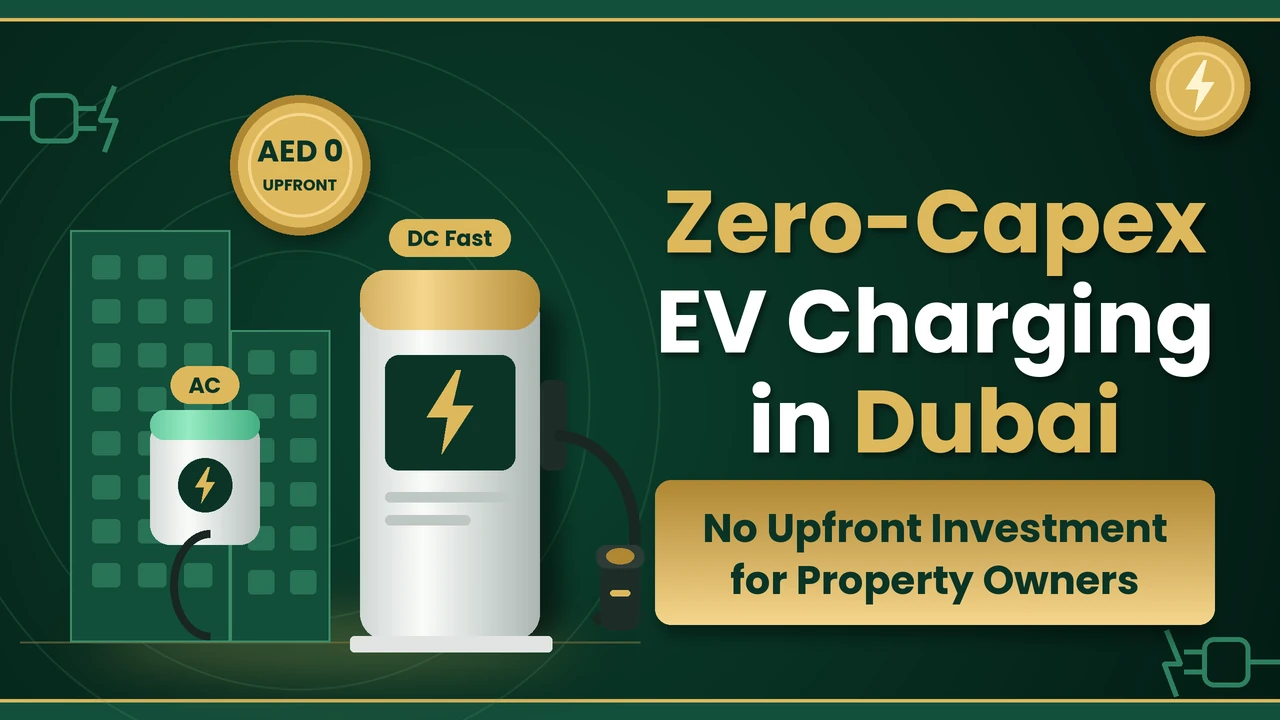
This is where the zero-capex model comes in. Instead of buying the equipment, the property owner hosts it. A charge point operator pays for the installation, owns the chargers and runs them day to day.
Below, we explain how that works in practice, who is responsible for what, and how to tell whether it suits your building.
What “Zero Capex” Actually Means
Capex is short for capital expenditure, the money a business spends upfront on assets. In a zero-capex EV charging arrangement, the property owner doesn’t pay for the charging hardware or the installation. The operator funds the project, owns the infrastructure and recovers its investment over time through charging revenue.
You’ll also hear these called zero investment EV charging stations, or EV charging as a service in the UAE. The labels vary, but the idea stays the same: you provide the parking bays and site access, and a specialist takes care of the rest.
This is different from buying chargers outright, where you own the equipment and usually pay to maintain it. It’s also different from a shared-investment joint venture, where both parties put money in and split the revenue.
How a Zero-Capex EV Charging Project Works
Every site is different, but most projects follow a similar path.
1. An Initial Conversation
It starts with the basics. What type of property is it? How many parking bays could be used? Who parks there, and for how long? A residential tower where cars stay overnight has very different needs from a mall car park where visitors stay for two hours.
2. Site Survey and Electrical Assessment
Next, the operator inspects the site. This covers available electrical capacity, the distribution board, cable routes, parking layout and whether load management could help more chargers share the existing supply.
This step also tells the operator whether the project makes commercial sense. Because the operator is paying, it needs to be confident the chargers will be used enough to justify the investment.
3. A Commercial Proposal
If the site works, you receive a proposal covering the number of chargers, the mix of AC and DC equipment, the agreement period and the responsibilities of each side.
4. Approvals and Installation
The operator coordinates the technical work and the required approvals. Depending on the property, that can involve building management, the owners’ association, electrical consultants and DEWA requirements for publicly accessible charging. DEWA started licensing independent charge point operators in 2024, which opened the door to privately funded charging in Dubai, as Gulf News reported. If you’d like a closer look at this stage, our guide to EV charger installation in Dubai walks through each step.
5. Launch and Daily Operation
Once the chargers are live, the operator handles user access, payments, remote monitoring, maintenance and driver support. Your team doesn’t need to answer calls about a cable that won’t release at 11 pm.
Who Pays for What?
This is usually the first question owners ask. The exact split always depends on the signed agreement, but a typical arrangement looks like this:
| Item | Property Owner | Operator |
|---|---|---|
| Charging hardware | No | Yes |
| Installation and electrical work | No (major supply upgrades are discussed case by case) | Yes |
| Approvals coordination | Gives consent and site access | Manages the process |
| Software, billing and payments | No | Yes |
| Maintenance and repairs | No | Yes |
| Parking bays | Provides them | Uses them for charging |
| Electricity | Agreed in the contract, often through sub-metering | Agreed in the contract |
Read the electricity clause carefully. It’s the item that varies most from one agreement to another.
Why Dubai Property Owners Are Choosing This Model
No upfront spend. The budget you would have set aside for chargers stays available for other priorities, whether that’s a lobby refurbishment or a cooling system upgrade.
A visible amenity. Residents, tenants and guests increasingly expect to charge where they park. A building that offers it feels current. One that doesn’t may start to feel dated.
No extra work for your team. Committees and facilities teams already have plenty on their plates. With an operator-run model, faults, billing questions and maintenance visits sit with the operator.
Less technology risk. Charging equipment and software keep evolving. When the operator owns the hardware, keeping it working and up to date is its responsibility.
Faster decisions. Without a large capital budget to approve, projects often move from discussion to installation more quickly.
The Trade-Offs Worth Knowing
Zero capex is a strong option, but it isn’t right for everyone.
First, the charging revenue largely goes to the operator, since the operator carried the investment. If earning income from charging is a priority, a shared-revenue or client-owned model may suit you better.
Second, these are long-term agreements. Check the duration, the exit terms and what happens if the building is sold or redeveloped.
Third, you have less say over pricing and equipment brands. The operator sets tariffs within the applicable rules, and the UAE already sets minimum rates for public EV charging.
Finally, not every site qualifies. A small building with very few EV drivers may not generate enough use for an operator to fund the project on its own.
Which Properties Suit Zero Investment EV Charging?
The model works best where cars stay parked for a while and demand is likely to grow.
- Residential towers and gated communities. A building in JVC where residents park overnight is a natural fit for managed AC charging.
- Hotels and serviced apartments. Guests can charge overnight, and the hotel offers the service without buying equipment.
- Offices. Employees can charge during working hours, which makes the car park more useful.
- Malls and retail destinations. Shorter visits may justify a DC fast charger alongside AC units.
- Parking operators. Busy car parks in areas such as Business Bay or Dubai Marina can turn existing bays into managed charging points.
Commercial fleets with tight schedules often need a different setup built around high-power depot charging. That’s usually planned as a separate project.
Zero Capex vs Other EV Charging Models
| Client-Owned (EPC) | Zero Capex | 50/50 Joint Venture | |
|---|---|---|---|
| Upfront cost to owner | Full | None | Shared |
| Who owns the chargers | Property owner | Operator | Shared |
| Charging revenue | Owner | Mainly operator | Split |
| Day-to-day operation | Operator, if appointed | Operator | Operator |
If you’re still deciding between AC and DC equipment, our guide to EV chargers in the UAE explains the differences in plain terms.
Questions to Ask Before You Sign
Before agreeing to any zero-capex proposal, get clear answers to these:
- How long is the agreement, and what are the exit terms?
- Who pays for electricity, and how is it measured?
- What response time do you commit to when a charger stops working?
- Who handles complaints and questions from drivers?
- Can more chargers be added as demand grows?
- What happens to the equipment when the agreement ends?
- Is the operator set up to meet DEWA requirements for public charging?
A good operator will answer all of these without hesitation and put the answers in writing.
How DAP Charging Handles Zero-Capex Projects
At DAP Charging, our Zero Capex model means we install, own and operate the charging infrastructure at your property. We manage the site assessment, installation, payments, monitoring and ongoing support, so the building gets a working charging service without the capital outlay.
We already operate charging in Dubai Marina, JVC, Business Bay and Jumeirah, covering residential, commercial and destination sites. Drivers can plan a charging visit through our Reserve Parking page.
If zero capex isn’t the right fit, we also offer client-owned EPC projects, a 50/50 joint venture, and RE-UP upgrades that convert older AC chargers to DC fast charging. The right model depends on your site, your users and how involved you want to be.
Final Thoughts
Zero-capex charging removes the biggest barrier most property owners face, the upfront cost. In return, you give up most of the charging revenue and sign a longer agreement. For many residential buildings, hotels and offices in Dubai, that’s a fair trade, especially when the alternative is having no charging at all.
Thinking about EV charging for your building? Email us at hello@dapcharging.com or use the contact form on our website. Our team replies within four hours.